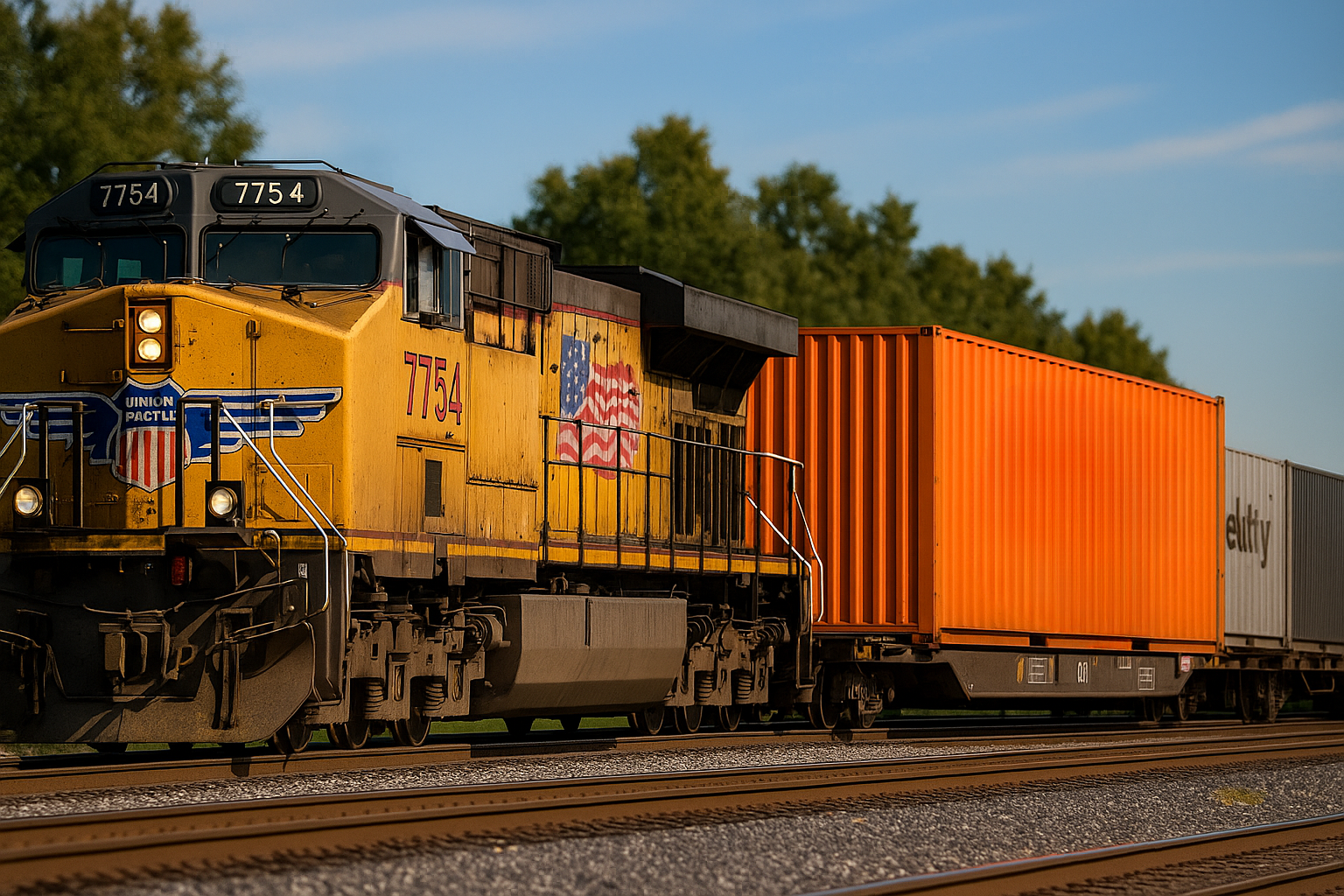
Rail intermodal.
Port to door, one move.
Move your ocean container inland by double-stack rail, then drayage to the dock. Lower cost than trucking on the long haul, far less carbon, all on a single bill of lading and tracked end to end.
How It Works
Five steps from
ramp to doorstep.
At the Ramp
Container lands at port or rail ramp
Book + IPI
Rail booked, routed to inland ramp
Double-Stack
Loaded two-high on the railcar
Line-Haul
Rail run to destination ramp
Final Drayage
Trucked the last mile to your door
Why Rail
The long-haul advantage.
On routes more than a few hundred miles inland, rail beats the truck on cost and carbon while running to a dependable schedule. Here is where it wins.
Lower Cost on Long Hauls
Hundreds of containers per train on one crew and one fuel burn. Past roughly 700 miles, double-stack rail typically undercuts over-the-road trucking on the same box, and the gap widens with distance.
Far Lower Carbon
Rail moves a ton of freight much further per gallon than a truck, around 75% less CO2 per ton-mile. We can attach the estimated savings to your shipment for your own reporting.
Reliable Schedules
Intermodal trains run to fixed departure slots, not traffic and driver-hour limits. Transit windows hold steady, which makes inland planning predictable.
Double-Stack Capacity
Containers ride two-high on a single well car, so a single train absorbs huge volume. That capacity keeps space open and per-container cost down on the busiest corridors.
Decision Guide
IPI or port-and-truck?
Both get your box inland. IPI builds the rail leg into the ocean move under one carrier. Port-and-truck stops at the port and hands off to a separate trucker. Here is the breakdown.
IPI (Interior Point Intermodal)
Carrier rails the box past the port to an inland ramp
Port-and-Truck
Box stops at the port, a separate trucker hauls it inland
Not sure which fits your destination? We model both for your lane and quote whichever lands the box cheaper and cleaner.
Network
Every inland connection.
Ocean-rail, cross-border, domestic, and rail-truck combinations, all stitched into one move so your container reaches the final destination without you juggling carriers.
Ocean-Rail Intermodal
Direct rail from major ports to inland ramps on a single bill of lading, with customs clearance coordinated into the move.
Cross-Border Rail
Canada and Mexico connections, USMCA compliant, with border crossing and in-bond transportation handled for you.
Domestic Rail
Coast-to-coast reach across the Class 1 railroads, with interline agreements and real-time tracking the whole way.
Rail-Truck Combination
Drayage from the destination ramp plus final-mile delivery, scheduled flexibly for urban and regional distribution.
30+
Countries with agents
50+
Rail terminals reached
24/7
Tracking and support
Optimization
Transload into a 53-foot domestic unit.
On high-volume freight, restuffing ocean boxes into larger domestic trailers near the port or ramp can cut the number of inland moves and lower your per-unit cost.
Consolidate the cargo
Cargo from one or more 20 or 40-foot ocean containers is restuffed into a single 53-foot domestic trailer or container at a facility near the port or ramp.
Fit more per move
A 53-foot unit holds more than an ocean box, so the same volume travels in fewer inland moves, which can lower the cost per unit on large shipments.
Route inland efficiently
The consolidated unit then runs to the inland destination by rail or truck. We advise when the handling fee pays off against the move savings.
Pricing
What's in your intermodal rate.
One number on the quote, rail leg included. Everything below is rolled into the all-in rate unless it is called out as an add-on.
Included in the rate
- Rail line-haul (ramp to inland ramp)
- Ramp lift and container handling
- IPI routing to the inland ramp
- Double-stack railcar space
- Single through bill of lading
- Real-time container tracking
- Interline coordination across Class 1 railroads
- 24/7 operator support
Optional add-ons
- Destination drayage to your door (quoted per lane)
- Transload into a 53-foot domestic unit (per shipment, volume dependent)
- Chassis at the ramp (carrier daily rate)
- Ramp storage / dwell (if box sits past free time) (railroad daily rate)
- Reefer plug-in and genset for inland power (lane dependent)
- Hazmat surcharge (IMO-classed cargo) (varies by class)
- Gateway Shield insurance (tiered by cargo value)
- Customs brokerage (entry filing beyond ISF) (quoted per entry)
- Duty + tariff + MPF + HMF (passed through at cost)
- Ship Green carbon offset (plus 2.5% of rate)
We quote everything up front. If something changes mid-transit (rail fuel surcharge, ramp congestion, additional handling) we email you a pre-approval before billing it.
Paperwork
Documents you'll need.
Upload these in the Gateway portal and we handle the filing. Missing a doc? We flag it before it causes a customs hold or a missed rail cutoff.
Bill of Lading
The ocean or master BOL covering the container. Under IPI this is the single through document that carries the box from the port to the inland ramp.
Customs Release
Proof the container has cleared customs at the port of arrival. Rail cannot move the box inland until it is released.
Rail Waybill
The rail contract for the line-haul leg. Gateway generates and files it with the railroad as part of booking, you do not produce it.
Weight / VGM Certificate
Verified gross mass of the loaded container. Rail enforces weight limits per box and per railcar, so the certified weight confirms the box ships compliantly.
Certificate of Origin
USMCA or other trade-agreement claim? Upload the signed COO so the cargo clears at the preferential duty rate instead of full MFN.
Hazmat / MSDS
Safety Data Sheet for IMO-classed cargo moving by rail. Must show UN number, proper shipping name, packing group, and emergency contact.
Trade Lanes
Intermodal corridors we run.
A sample of the inland rail corridors we move every week. Transit windows are typical ramp-to-ramp ranges, so we quote your exact lane on request.
Questions
Everything else about rail.
The eight questions intermodal shippers ask us most. Don't see yours? Email sales, response within 4 business hours.
On long hauls, yes. Once a port is more than about 700 miles from the inland destination, double-stack rail line-haul typically undercuts over-the-road trucking on the same box, often meaningfully. A single intermodal train carries hundreds of containers on one crew and one fuel burn, so the per-container cost drops as distance grows. On short hauls under a few hundred miles, a truck is usually faster and competitive on price, so we quote whichever wins your lane.
Newsroom
Latest updates.
Rail & Intermodal
Port to doorstep. One move, one bill of lading.
Double-stack rail from the port to the inland ramp, then drayage to your dock, tracked end to end with same-operator support from booking to delivery.